Dan Steingart
## On Batteries in Buildings
First Post (2023-01-09T14:05:00.000-05:00)
*[WNYC](http://www.wnyc.org)** asked me to comment on a storage battery under consideration for a building in Brooklyn. The published segment is **[here](https://gothamist.com/news/energy-companys-plan-to-place-150-ton-batteries-on-williamsburg-rooftop-ignites-tenants-fears)**.*
*I know nothing about the details of this installation, but the prompt from WNYC expressed concern with batteries in buildings, given some recent e-bike fires. I had a nice conversation with the team, and I am pasting my full comments here for deeper context, as I don’t know what portions will be on the radio.*
It’s important to note that the root cause analysis of the scooter/e-bike fires is incomplete. It is unclear to me what triggered the events. For example, was it the battery pack apropos of nothing (it just exploded), or was it related to the charger and BMS system? I’ve seen a significant amount of speculation but no actual post-mortem analyses. If you have any you can share, I’d be happy to review them.
To your [WNYC’s] specific questions:
*Are these storage batteries different from the kinds of batteries found in electric bikes/scooters that have a reputation for exploding? Ie, Are they safer, different structurally, is it fair to compare them to ebike batteries?*
They certainly should be different. While the specific chemistries and chemicals will be similar (within the “lithium-ion” class of batteries), the following aspects will be quite different.
- The specific construction and validation of the “grid” cells in a grid storage application need to last > 10 years. As such, quality control and assurance need to be much higher. To be clear: new e-bike batteries are incredibly safe; what gets dicey is when e-bike modules are rebuilt and refurbished with cells of unknown origin and state. For a grid storage battery, the cell and component traceability chain should be much higher.
- The module design will be substantially different: the module defines the way the cells are grouped. In a grid storage application, each cell, or at least small groups of cells, are monitored for temperature, voltage, and current (or charge/discharge rate) with high frequency. These measurements provide composite understanding as indicators of the state of charge (e.g., fuel gauge), state of health (e.g., how much the cell has depredated), and state of safety (is the cell or module likely to overheat if use continues). These modules can be then “switched out” or isolated as required for maintenance and safety operations. By comparison, an e-bike/scoot battery is one “module” with far fewer sensors.
- The pack design (how the modules fit together) is substantially different: the modules are grouped and monitored as described above in a climate-controlled environment, and the FDNY has stringent requirements for how the pack should prevent fire propagation, whether or not the cells are the root cause (i.e., a battery should neither start nor contribute to a fire).
So long story short, by multi-level design, there are layers of safety that can and should exist for a building battery that are harder to implement in 2023 for an e-bike battery. I’d liken it, roughly, to a propane tank v.s. a gas line. We wouldn’t use a propane tank in a building regularly because, particularly a beat-up one, we always use gas lines. The gas is essentially the same, but how it is monitored, handled, and regulated is quite different.
*Do you know of any other buildings hosting battery storage in NYC?*
It’s just starting. There’s a large facility by ConEd that’s not what you’re asking for; the FDNY has just allowed this type of system so this is all new stuff.
*What are the benefits of energy storage like this? Is it the wave of the future here in NYC?*
It’s important to break this question up. **Distributed energy storage **is quite helpful for cities. Whether not they should be **in buildings** or **adjacent to buildings **is a tricky question. In NYC,> 50% of the average electricity bill relates to electricity distribution, meaning it’s more expensive to move the electrons than generate them. Distributed energy storage acts as a shock absorber for the grid, making it less brittle and energy more reliable, and if done well, it reduces the cost of electricity.
Whether or not this happens at a building level (behind the meter) or a substation/block level (in front of the meter) isn’t so important technically. Still, it has implications for who owns, maintains, and benefits from the asset. I think it’s important to key into the equity aspects here. It’s important that as we move to distributed energy resources (solar, batteries, etc.), they’re implemented to alleviate, rather than exacerbate, energy poverty. Where and how the cells are used matters. I am concerned that too much reliance on building owners and private corporations will not benefit those who need lower-cost electricity the most. All energy assets are bought at the margin: a building is not going to buy extra energy storage, and therefore a battery in a building is less likely to benefit those outside the building **unless** an incentive structure is put into place where the building owner is compensated to discharge the battery into the grid.
I think of this as an “internet of energy”: if batteries can be operated this way and benefit all, then building internal systems is very interesting. If not, and they create energy islands for the wealthy and privileged, it’s more of the same.
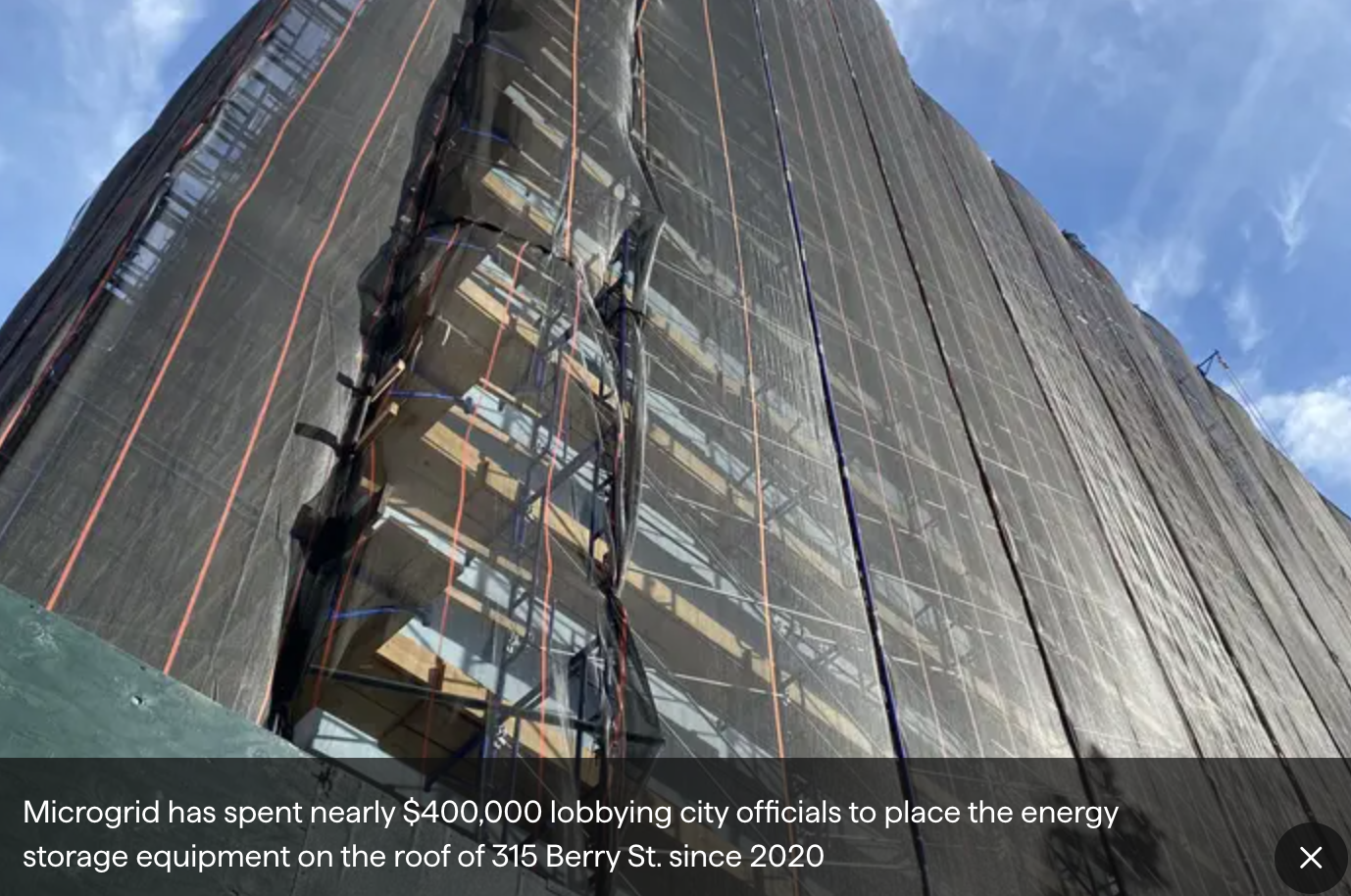
From WNYC/Gothamist